
Does digital art history substitute the need for art tourism?
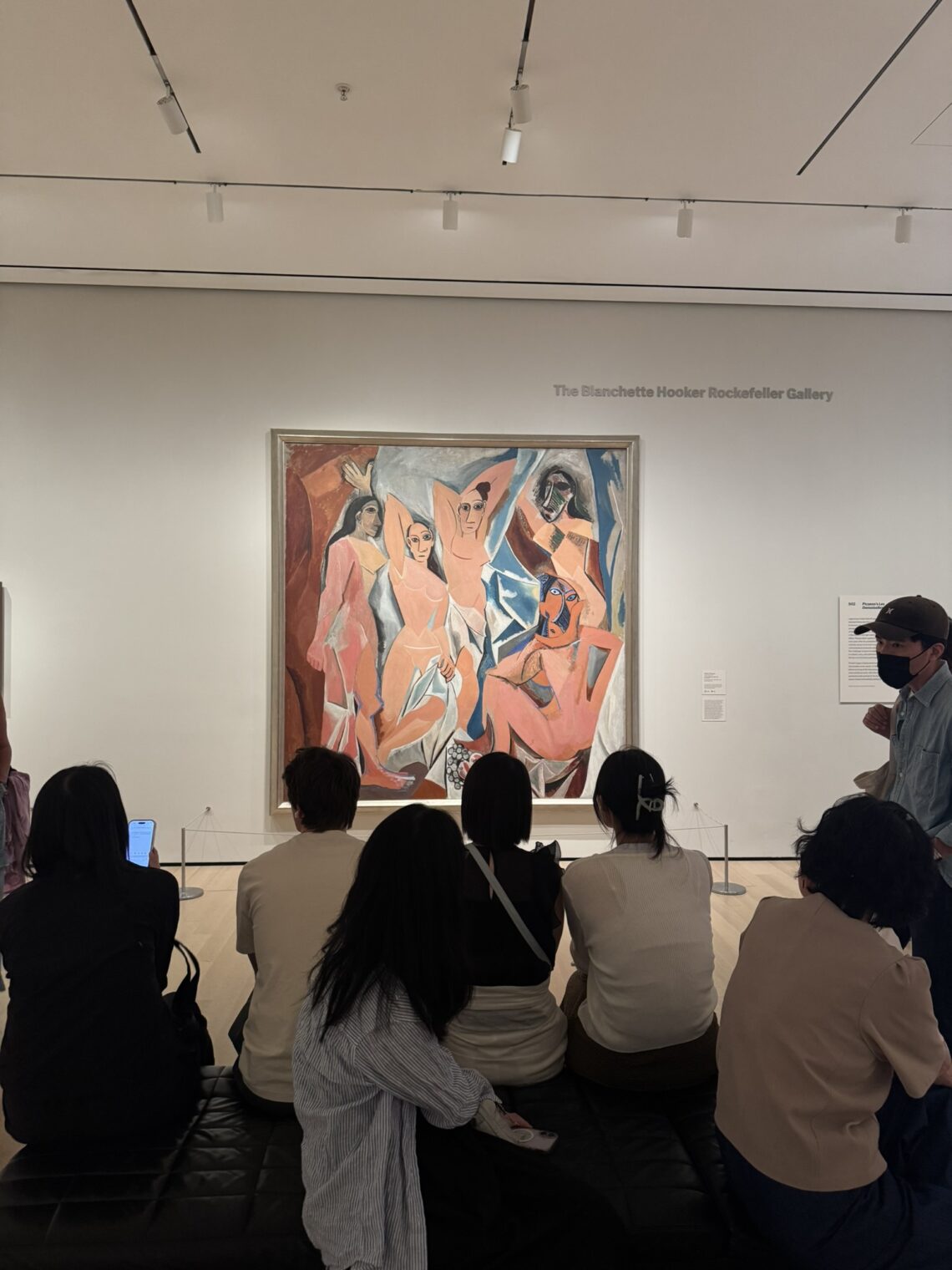
I recently took a trip to the Museum of Modern Art in New York City, a museum that is six floors of some of the best-known artworks in the canon of Western Modern art. Virtually every gallery had a work of art that I had either studied extensively or a work by an artist I have studied extensively. One of the highlights of the collection is Pablo Picasso’s Les Demoiselles d’Avignon, a large-scale painting that revolutionized depictions of the human form through a distinct and developing Modern subject. The painting has established a reputation as emblematic of several converging art movements that emerged from the early 20th century that solidified Les Demoiselles as one of Picasso’s most analyzed works of art. It is an essential work of art to study in university level art history courses; I personally have studied the work in multiple classes. So, when I finally saw Les Demoiselles in person for the first time, I found that I had very little left to engage with.
In The Digital Transformation of Art History, a chapter from the 2020 book Companion to Digital Humanities and Art History – Harald Klinke explores the notion of “distant viewing” (p.34). Alois Riegl coined the term in 1897/8 – originally Fernsicht – to distinguish how our modes of viewing are altered based on our physical proximity to a work of art. When up close to a painting, we can study and understand that the work is made of brushstrokes and, in turn, when far away from a painting, we can employ methodological study the broader work of art. This framework was developed assuming the viewer would be physically in front of a work of art, so, the question is, how do digital renderings of art change our modes of viewing?
The field of art history began in grand tours and flaneur style connoisseurship. Art pilgrimages remain the peak to any art historical research today (otherwise, why would we set departmental travel funds aside for students wanting to see researched works in person?). Yet, for me with Les Demoiselles, I felt that the MoMA had done sufficient work in producing digital renderings of the painting that I as a viewer and student had enough visual information to study the work of art through digital-born distant viewing. I can admit, I am not a Picasso scholar, but I am a Modernist, and in that moment, I felt surprised that I extracted very little from my close viewing experience with Les Demoiselles. So, does this mean that museums are obsolete? Do we even need to go see works of art in person at all if their digital stand-in counterparts do the job? I’d even ask one question further: hypothetically, could you become an art history expert without ever setting foot into a physical museum?
Klinke counters these questions by posing specific difficulties of relying on digital-only modes of viewing. As he sees it, our current systems of digital viewing do not serve as complete enough of platforms to support research questions (p.36). The data associated with works of art could be irrelevant, insufficient, and invalid. Their visualizations only tell part of the story behind the work and lack distinct interactivity. Why would a researcher have to travel to the MoMA to see Les Demoiselles d’Avignon when they could just go online and look up an image of it themselves? Digital art history aims to do what conventional art history cannot – it allows equal access. Yet, as a consequence of doing so, Klinke observes that art historical research is largely conducted alone. Klinke argues that digital art history should not replace conventional methods of art history and should serve as an extension of traditional approaches that enhances and deepens understanding.
Where spaces like museums, libraries, and classrooms may feel obsolete now that you can just look up the same information online, digital spaces do not allow the same level of collaborative communication. Distant viewing when done alone without contextual information is just looking. Collaboration through learning visual and digital literacy skills is the key to true art historical understanding. My viewing experience of seeing Les Demoiselles at the museum was not deeply stimulating, but this is because I have already done so much collaborative visual learning on the painting in the classroom. While I am still unsure if someone could become an expert in art history without ever setting foot into an art museum, I do feel strongly that someone cannot become an expert in art history by themselves. In creating this blog, here is my own kind of attempt at engaging in digital art history through a more social internet. I put my thoughts into the world with hopes that it creates collaborative and productive art historical discussion.


Despite Klinke, Langmead, and Jaskot’s support for the integration of digital methods into the future of art history, they also emphasized the essential collaborative component necessary in the field. I think that scholarly collaboration is important for any discipline, but I think it will be increasingly necessary for transdisciplinary collaboration with the integration of digital methods.
The stereotype of the “isolated scholar” at first seemed to be abolished by the “town square” quality of the slide library, but as the field replaced that technology with digital reproductions the scholar was seemingly exiled back to his or her own computer. Although it may be tempting for the scholar to resign once again to her desk in the Sloane Art Library, collaborative opportunities must be intentionally created to combat this isolation.
Langmead discussed one such method for bringing students together to learn with the Visual Media Workshop at the University of Pittsburgh. Through student-led projects, participants in the Visual Media Workshop could learn how to use digital tools for analytical purposes together rather than in isolation. Students are not working with original art or studying it in-person, but digitization facilitates analysis and access in a collaborative space.
Despite the advantages for learning that digital remediations of work make possible, I think that it is important for art historians to still see works in-person. While digitization and digital tools provide remediations that can be beneficial for analysis, the experience of seeing and studying a work in the flesh has merit, too. To experience the work phenomenologically is as important as reading about it or studying its reproductions. Viewing a work in-person also creates a collaborative experience shared by its viewers.
The question of whether physical museums need to exist as institutions open to the public is also a valid question in this age of increasing digitization. If the museum’s collections are already organized neatly into an easily searchable database, why bother visiting if the works that pique one’s interest are already digitally available? An answer to this question may be the human creative element of the museum. Together, museum visitors are subjected to the same experience as determined by curators of exhibitions and collections. From these arrangements, new meanings may be uncovered with a work interacting with others rather than presented in digital isolation.
Despite the necessity for in-person art viewing, it is important that digital resources do allow greater access to artworks. It seems that the digital art history and the larger field of art history will be inseparable in the near future, and that will only push scholars to use digital tools beyond analog substitutes and into the analytical realm. This will all be necessitated with greater collaboration among fellow scholars and across disciplines.
I think you make some really good points on the benefits and disadvantages of so-called “distant viewing” in this post. While it is incredibly difficult to fully capture the aura (shoutout Walter Benjamin) of a work of art through a reproduction–regardless of how faithful it may be–there are still a lot of benefits to examining works of art through a distant lens.
Most notably, the increase in digital tools for distant viewing (i.e., photographs) has greatly increased accessibility to works of art that the general populace would otherwise never have the chance to view in person. Pieces that never travel through exhibition loans or ones generally considered too fragile to be on view in a gallery space can now be accessed from anywhere in the world, so long as a person has an Internet connection and a means to access the digital images. I always think about “Hellelil and Hildebrand, the Meeting on the Turret Stairs” by Frederic William Burton (1864, National Gallery of Ireland) in situations like these. Since it’s a watercolor on paper, conservators decided that the piece should only be on view–and therefore subject to light exposure from the gallery it’s held in–for two hours a week. Unless you’re at the National Gallery of Ireland in Dublin for those two hours a week, you’re out-of-luck to see Burton’s piece in person. But the image provided by the National Gallery is considerably lackluster compared to the actual viewing experience of the piece, as it greatly mutes the colors that the museum seeks to preserve (https://www.nationalgallery.ie/art-and-artists/highlights-collection/hellelil-and-hildebrand-meeting-turret-stairs-frederic vs a photograph here: https://commons.wikimedia.org/wiki/File:%22El_encuentro_en_la_torre%22_de_Frederick_William_Burton,_1864._National_Gallery_of_Ireland.jpg).
But discussions of pieces like Burton’s play directly into one of your main points: museums are still necessary for the viewing experience. They provide greater access to works of art than digital images or other reproductions ever will, so long as a viewer has the means to travel to visit them.